1Do you need a music licence?
If customers can hear commercially released music, that is a public performance under the Copyright, Designs and Patents Act 1988, and you need permission. In practice that means TheMusicLicence, the single joint licence PPL and PRS for Music sell together through PPL PRS, because a normal playlist crosses both of their repertoires.
There is no small premises exemption in the UK. The two provisions that came closest, sections 67 and 72(1B)(a) of the Act, were both repealed, the latter by regulation 4(1) of SI 2010/2694. So floor area, seat count and the number of loudspeakers make no difference, and it makes no difference whether the sound comes from a radio, a CD or a streaming account. If it can be heard by customers, it is licensable.
There are also no statutory damages here, as there are in the United States. A rights holder claims damages or an account of profits, with costs and an injunction on top, and PPL PRS can back-date a licence over any period you were playing music without one.
RadioB2B removes the question. Every track is licensed at source through RadioPRO Ltd, a UK collective management organisation, and none of it is in the PRS for Music or PPL repertoire, so no public performance royalty arises on what you play through the service.
2Programming an unbroken mood
Spas are the one trade where the schedule should barely move. What matters is that nothing jars: no gaps, no sudden lifts, no lyrics in a treatment room.
| Period | What works |
|---|---|
| Opening | Ambient near 55 BPM. The building should already sound calm before the first guest arrives. |
| Morning treatments | Hold 55 to 65 BPM, instrumental and gapless through back-to-back appointments. |
| Midday | Slightly warmer at reception for the busier changeover, unchanged in the treatment rooms. |
| Afternoon | Back to 55 to 60 BPM for the long afternoon bookings. |
| Close | Unchanged. A spa should never sound like it is closing while a guest is still in a robe. |
You can try the scheduler on the live console on our home page before signing up for anything.
3Zones: treatment rooms, relaxation, reception, changing rooms
Each independently controlled output is a zone, and each runs its own station and volume.
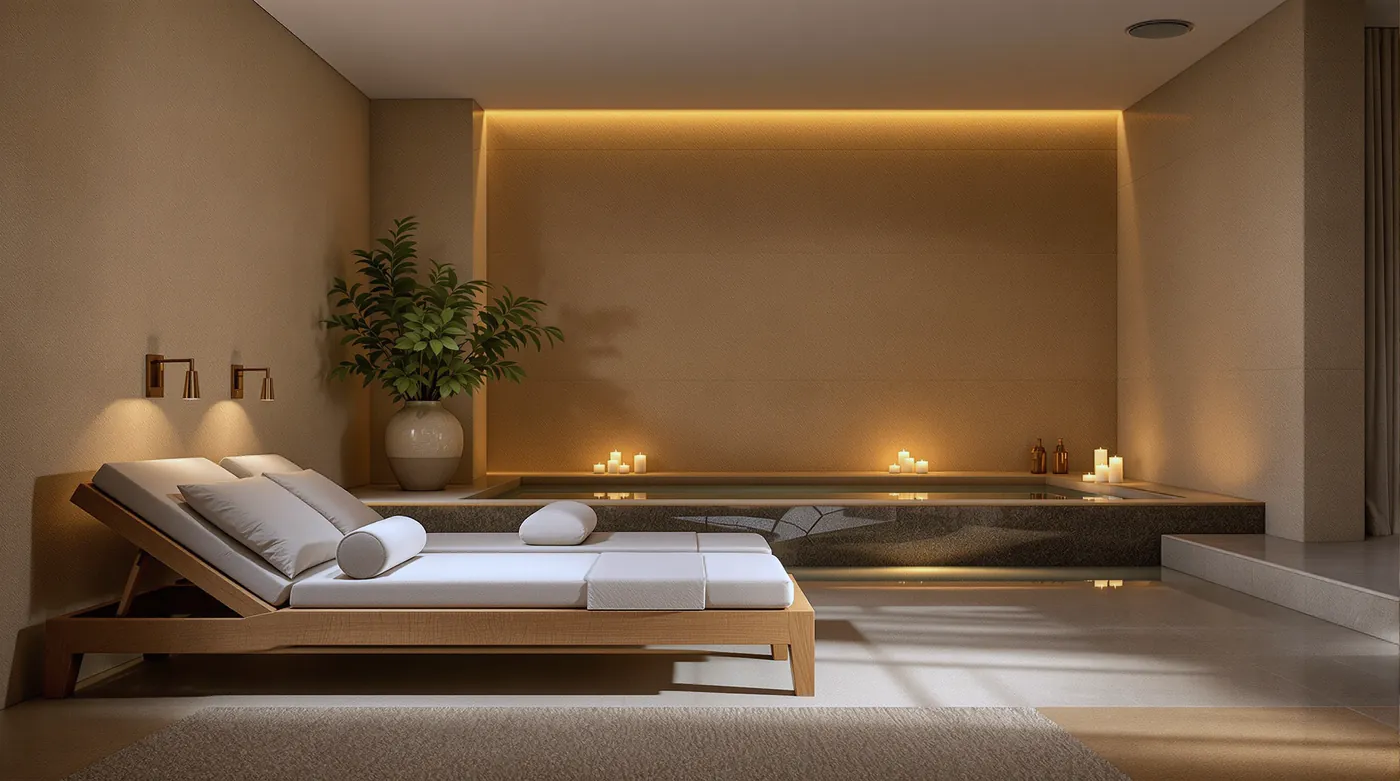
- Treatment rooms on gapless ambient, lyric free, with therapists able to adjust volume in the room.
- The relaxation lounge, warmer and slightly fuller, where guests sit between treatments.
- Reception and retail, brighter and a little louder, because it is a different job.
- Changing rooms and the wet area, where a steady bed of sound gives people privacy to talk.
4Hardware you already own
There is nothing to buy and nothing to install. The player runs in any browser and casts directly to Sonos, Chromecast and AirPlay. There are iOS and Android apps as well, so staff can change a zone without opening a laptop, and when the internet drops the player keeps going from a cached queue rather than leaving you in silence.
5Treatment and membership messages
Record your own audio and schedule it into the rotation. A membership prompt in the reception zone only, a seasonal treatment offer, or a quiet reminder about phone use in the relaxation lounge. Never in the treatment rooms, where an announcement would defeat the point.
6What it costs
£89 a year, per year, flat, music included. That covers the full catalog, background music video channels for any screens, the scheduler, your own announcements, staff accounts and the Music Licence Certificate. It does not scale with your square footage or your opening hours, which is the mechanism that makes a PPL PRS bill climb.
For comparison, TheMusicLicence costs £238.33 a year plus VAT for a salon with five chairs or fewer, and PPL PRS can back-date a licence over any period you were playing music without one. Licence free playlist libraries in the UK sit at about 15 pounds a month plus VAT, and licensed services that still leave you owing PPL PRS run from about 22 to 40 pounds a zone a month. See how the routes compare.
Try it in your own space
Fourteen days free, no card required. Build a day's schedule, cast it to the speakers you already have, and hear how the room changes before you decide anything.
7Questions
Do spas need a music license?
Yes, if commercially released music is audible to clients. That is a public performance under the Copyright, Designs and Patents Act 1988, and it covers treatment rooms and relaxation areas as much as reception.
Why does gapless playback matter in a treatment room?
Because a silence between tracks is exactly the moment a guest comes back to the room. Gapless crossfading keeps the bed of sound continuous through a whole treatment, which is the single most noticeable difference between a proper system and a consumer playlist.
Can therapists adjust the volume in their own room?
Yes. Each treatment room can be its own zone with its own volume, so a therapist can set the level for the client in front of them without affecting the rest of the building.
What does it cost for a spa?
A flat £89 a year, including the music. TheMusicLicence costs £238.33 a year plus VAT for a salon with five chairs or fewer, and it supplies no music at all.
Cost figures are indicative 2026 published minimums and typical market pricing, not quotations. General information, not legal advice. See our Terms of Use and Service Agreement.